


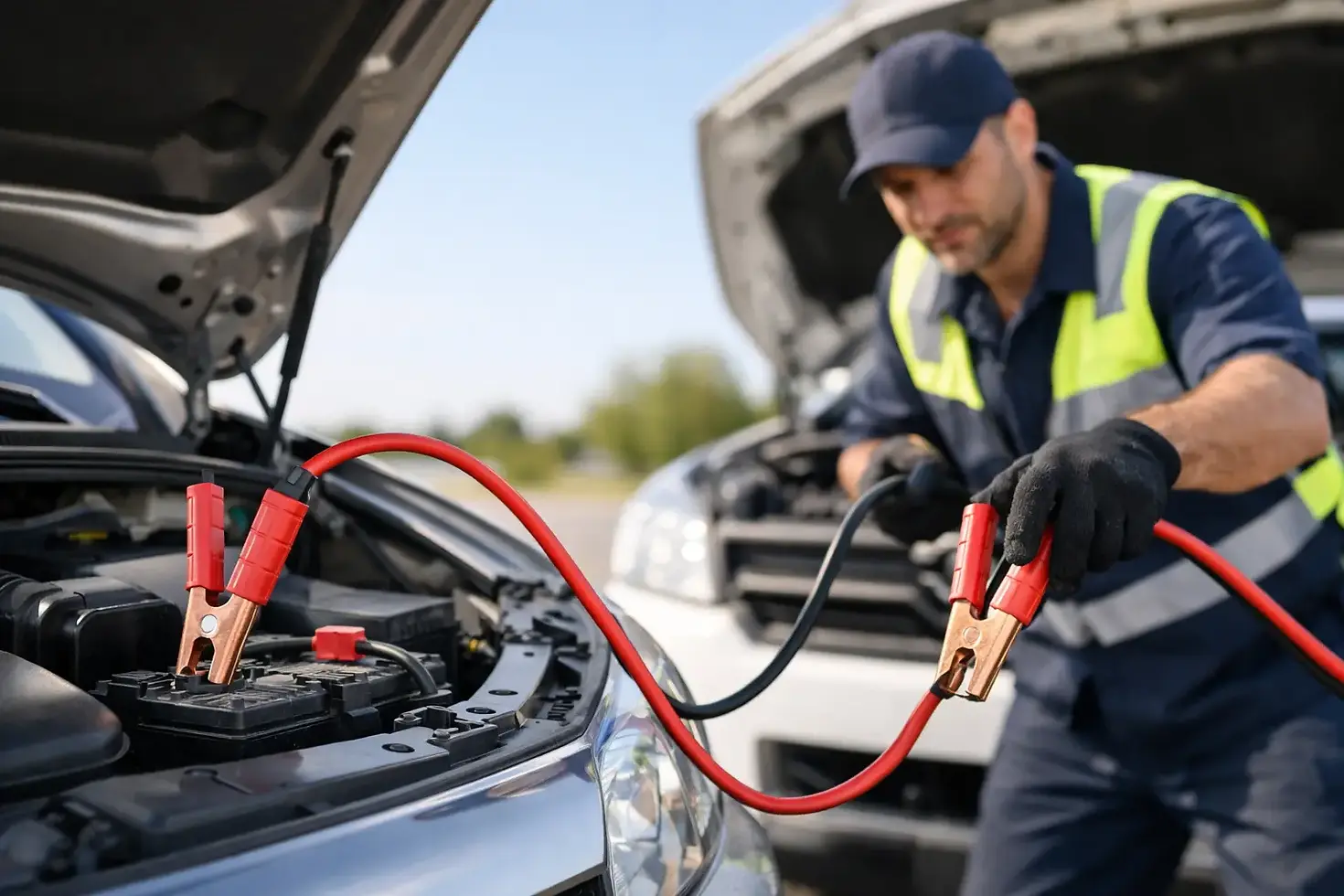
How Roadside Jump Starts Work

You turn the key, hear a click or nothing at all, and suddenly the rest of the day gets put on hold. That is usually when people start wondering how roadside jump starts work, and whether a quick boost is all the car needs or just a temporary fix.
A roadside jump start is a controlled way to give a weak or dead battery enough power to crank the engine. Once the engine starts, the alternator takes over and supplies electrical power while also recharging the battery. On paper, it sounds simple. In real life, a good jump start depends on the condition of the battery, the charging system, the cable connection, and whether the vehicle has another issue that only looks like a battery problem.
How roadside jump starts work in real conditions
When a technician arrives for a jump start, the goal is not just to hook up cables and hope for the best. The first step is usually a quick assessment. If the lights are dim, the dash flickers, or the starter only clicks once, that points toward low battery voltage. If the vehicle has full power but still will not crank, the problem may be the starter, ignition system, neutral safety switch, or another electrical fault.
Assuming the battery is the issue, the technician connects an external power source to the vehicle battery. That source might be a portable jump pack or another vehicle with jumper cables. The extra power raises system voltage enough for the starter motor to turn the engine over. Once the engine catches, the battery is no longer doing all the work by itself.
This is where people often misunderstand the process. A jump start does not magically repair a bad battery. It only provides enough temporary power to get the vehicle started. If the battery is old, internally damaged, or unable to hold a charge, the problem can come right back after the engine is shut off.
What the technician is actually checking
A dependable roadside service should pay attention to more than whether the engine starts. Battery condition matters, but so do the connections and the charging system.
Corroded battery terminals can block current flow even when the battery still has life left in it. Loose terminal connections can create the same symptom as a dead battery. In some cases, cleaning or tightening the connection changes everything.
The technician may also look for signs that the alternator is not charging properly. If the battery needed a jump because the alternator has been undercharging, the vehicle might start and then stall later, or fail again after a short drive. That is why a jump start is sometimes the beginning of the diagnosis, not the end of it.
Why some cars start right away and others do not
Not every dead battery situation is equal. A battery that was drained overnight by a dome light or phone charger may recover enough to start quickly with added power. A battery that is several years old and has a bad cell may struggle even with a strong jump pack attached.
Temperature also plays a role. While Central California does not usually see harsh winter conditions like other parts of the country, heat is hard on batteries too. Repeated high temperatures can shorten battery life, evaporate internal fluid, and weaken overall performance. That is one reason a battery can seem fine for months and then suddenly fail.
Vehicle design matters as well. Some engines require more cranking power than others. Larger engines, high-compression engines, and vehicles with heavy electrical loads can be less forgiving when battery voltage drops.
The basic jump start process
The jump start itself follows a safe sequence designed to reduce the risk of sparks, electrical damage, or poor connection. First, the technician confirms the battery is the correct voltage for the vehicle and checks for visible battery damage. A cracked battery case, heavy leaking, or severe swelling changes the situation and can make a standard jump start unsafe.
Next, the power source is connected to the battery terminals in the proper order. Good contact is important. If the clamps are loose or attached to heavily corroded metal, the current transfer may be weak. After the connection is made, the technician may wait a short time to let some charge build in the battery before attempting to start the vehicle.
When the engine turns over and starts, the cables or jump pack are removed carefully. Then comes the part drivers should not ignore. The vehicle needs to run long enough for the charging system to put energy back into the battery, but even that may not fully restore it if the battery was deeply discharged.
Why driving after a jump start may or may not help
Many drivers have heard that they should drive around for 20 or 30 minutes after a jump start. That advice is not always wrong, but it is not a guarantee either.
If the battery is healthy and was only drained by leaving a light on, a decent drive may restore enough charge for normal operation. If the battery is near the end of its life, driving may help only a little. If the alternator is weak, driving may not recharge the battery properly at all.
Short trips are another problem. If you jump the car, drive ten minutes, and shut it off, there may not be enough recovered charge to restart it. That is why a technician may recommend battery testing or charging rather than assuming the issue is solved.
When a jump start is the wrong answer
A no-start condition does not always mean the battery is dead. That matters because repeated jump attempts can waste time and distract from the real fault.
If the engine cranks strongly but does not fire up, the issue is probably not a weak battery. It could be fuel delivery, ignition, sensor failure, or another engine-related problem. If there is no crank and full dash power, the starter or starter circuit may be at fault. If the battery keeps dying every day, there may be a parasitic draw that drains power while the car is parked.
There are also safety limits. A visibly damaged battery should be handled with caution. So should a battery giving off a strong sulfur smell or showing signs of overheating. In those cases, testing and replacement may be the safer route.
What roadside service should give you besides a start
Convenience matters when you are stranded, but clarity matters too. A useful roadside jump start service should help you understand what likely happened and what to do next.
That might mean telling you the battery appears weak and should be tested soon. It might mean pointing out corrosion at the terminals, or explaining that the alternator may not be charging as it should. If the problem looks bigger than a simple dead battery, the right next step may be mobile diagnostics or a shop visit instead of rolling the dice on another restart.
For local drivers, that is where working with a full-service provider makes life easier. A company like James Mobile Auto Repair can handle the immediate roadside need, then follow up with diagnostics or repair if the battery problem turns out to be something more.
How to reduce the chances of needing another jump
Batteries usually give some warning before they fail completely, but those signs are easy to brush off. Slow cranking in the morning, dimmer headlights at idle, electrical accessories acting weak, or needing more than one turn of the key are all worth paying attention to.
Regular battery and charging system checks can catch issues early. So can keeping terminals clean and making sure the battery is properly secured. If your battery is already several years old, especially after long periods of summer heat, it is smart to have it tested before it leaves you stuck in a driveway, parking lot, or on the side of the road.
A roadside jump start can get you moving again fast, and sometimes that is all you need. But the real value is knowing whether the battery simply got drained or whether the car is asking for a repair that should not wait. When you treat the jump start as a clue instead of just a quick fix, you give yourself a much better shot at driving away with confidence.


Comments