


Mobile Suspension Repair Explained for Drivers
- Kathryn Fitzgerald
- 26 minutes ago
- 5 min read

A sharp clunk over a driveway bump, a vehicle that pulls to one side, or a front end that feels loose can turn an ordinary commute into a stressful drive. Mobile suspension repair explained simply: a qualified technician comes to your location to inspect and repair accessible suspension components, saving you a trip to the shop when the job can be completed safely on-site.
For busy Visalia drivers, that convenience matters. But suspension work is not one-size-fits-all. Some repairs are well suited to mobile service, while others need shop equipment, a vehicle lift, or a wheel alignment afterward. Knowing the difference helps you make a safer and more informed decision.
What Your Suspension System Actually Does
Your suspension is more than the part of the vehicle that makes rides feel smooth. It is the system that keeps your tires in steady contact with the road. Springs support the vehicle's weight, shocks or struts control bouncing, and components such as control arms, ball joints, sway bar links, and bushings guide wheel movement.
When these parts are working together properly, your vehicle stays more stable when braking, turning, or driving across uneven pavement. When one component wears out, the problem can affect tire wear, steering response, braking distance, and overall control.
Suspension issues often develop gradually. You may get used to a rough ride or minor noise until it becomes hard to ignore. That is why an inspection is valuable before a small concern becomes a breakdown or a larger repair.
Common Signs You May Need Suspension Repair
A rough ride is a familiar sign, but it is not the only one. Pay attention when your vehicle continues bouncing after hitting a bump, dips heavily when braking, or leans more than usual in turns. Those symptoms can point to worn shocks or struts.
Noises matter, too. Clunking, rattling, squeaking, or knocking over bumps may come from worn sway bar links, loose hardware, damaged bushings, or ball joints. The exact sound does not confirm the failed part, but it gives a technician a useful starting point.
Uneven tire wear is another warning. If one edge of a tire is wearing down faster than the rest, suspension wear or poor alignment may be involved. A vehicle that drifts, pulls, vibrates, or has a steering wheel that no longer sits straight also deserves prompt attention.
Do not assume every steering or ride complaint is a suspension problem. A low tire, damaged tire, brake issue, wheel bearing, or steering component can create similar symptoms. Proper diagnosis prevents replacing parts that are not actually causing the issue.
What Mobile Suspension Repair Can Handle
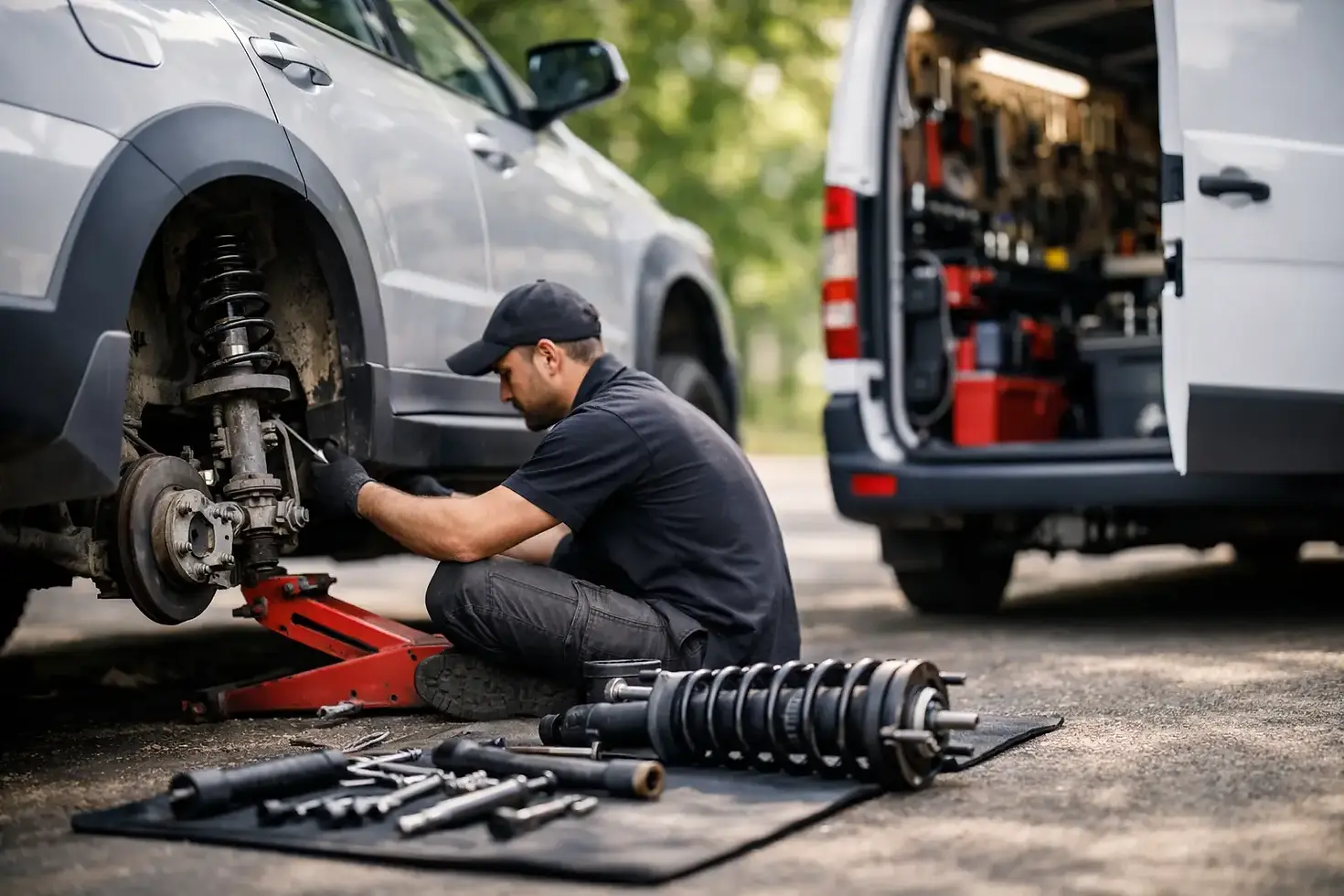
Mobile service is a practical option when the vehicle is parked in a safe, reasonably level place and the repair does not require specialized shop machinery. Depending on the vehicle and condition of the parts, a mobile technician may be able to inspect and replace sway bar links, shocks, struts, certain control arms, bushings, ball joints, or related hardware.
The process starts with checking the concern, looking for play in worn components, inspecting for leaking shocks or struts, and examining visible tire wear. A technician may also check mounting points and confirm that nearby steering or brake parts are not contributing to the problem.
On-site repair is especially helpful when a vehicle is safe to work on but uncomfortable or unreliable to drive across town. It reduces the disruption of arranging transportation, waiting at a shop, and losing time from work or family responsibilities.
James Mobile Auto Repair can assess suspension concerns where your vehicle is located and help determine whether the repair can be completed there or should move to the shop. That combination gives customers a clear next step rather than leaving them to guess whether their vehicle is safe to drive.
When a Shop Repair Is the Better Choice
Some suspension repairs require a shop for good reasons. Wheel alignment is the most common example. Replacing struts, control arms, tie rod ends, or other components can change alignment angles. Even when the vehicle drives afterward, incorrect alignment can cause rapid tire wear and poor handling.
A shop is also the better setting when rusted fasteners, seized components, broken bolts, or extensive damage make the repair more involved. California's dry climate can be easier on undercarriage parts than areas with heavy road salt, but age, dirt, heat, and previous repairs can still make hardware difficult to remove.
Larger jobs may require a vehicle lift for access, additional tools to safely compress springs, or more time to inspect related damage. If a technician recommends shop service, that is not a loss of convenience. It is the right approach for completing the job safely and correctly.
Safety Comes Before Convenience
Suspension problems range from annoying to dangerous. A leaking strut may make the ride less controlled, while a severely worn ball joint or broken control arm can create a serious loss-of-control risk. If the vehicle feels unstable, makes loud metal-on-metal noises, pulls sharply, or has a wheel sitting at an unusual angle, avoid driving it until it has been inspected.
Parking on flat, solid ground is also important for mobile work. A technician needs enough room to safely lift the vehicle, remove wheels when needed, and work around traffic. A crowded street, steep driveway, soft dirt, or active roadway may make an on-site repair unsafe or impractical.
In those situations, roadside assistance or transportation to a shop may be the better call. The goal is not simply to get the vehicle moving again. It is to make sure it is repaired in a way that protects you, your passengers, and everyone else on the road.
What to Expect From a Mobile Suspension Appointment
Before the appointment, share the year, make, model, symptoms, and when the issue happens. Mention whether the vehicle has been lowered or lifted, has aftermarket wheels, recently hit a pothole, or had suspension work done before. Those details can affect both diagnosis and parts selection.
Try to describe the concern in plain language. For example, say that the noise happens when turning left into a driveway, braking at low speed, or crossing speed bumps. You do not need to know the name of the failed part. Clear observations are more useful than trying to self-diagnose from a sound alone.
During the visit, ask what the technician found, whether related components show wear, and whether an alignment will be needed after the repair. A trustworthy recommendation should explain what needs attention now, what can be monitored, and why the proposed repair makes sense.
Repair Decisions That Protect Your Budget
Suspension repairs can vary widely in cost because vehicles use different designs and parts. A sway bar link replacement is generally a different level of work than replacing a full strut assembly, control arm, or multiple worn steering components. Parts quality, rust, access, and the need for alignment all affect the final price.
It can be tempting to replace only the single part making noise. Sometimes that is the right answer. Other times, replacing worn components in pairs makes more sense, particularly with shocks and struts. If one has failed from age and mileage, the matching component may be close behind. The best choice depends on condition, budget, and how long you plan to keep the vehicle.
Addressing suspension wear early can also help preserve tires. New tires are too expensive to sacrifice to a vehicle that is bouncing excessively or driving out of alignment. A careful inspection gives you the information needed to prioritize repairs without guessing.
A suspension concern does not have to mean an immediate, complicated shop visit. Start with a professional inspection, choose mobile service when the repair and location are appropriate, and use shop support when the job calls for it. That approach keeps the decision practical and helps you get back behind the wheel with greater confidence.


Comments